Heart Rate Variability (HRV) is a common metric in healthcare, wellness, and athletic settings. HRV values provide insight into the autonomic nervous system (ANS) balance and whether the body is in a more stressed or relaxed state. The sympathetic nervous system (SNS) and parasympathetic nervous system (PNS) are branches of the ANS. SNS activation is also known as “fight or flight.” The sympathetic nervous system is more dominant during immediate stress, danger, or high energy demand. PNS activation is referred to as “rest and digest” or “rest and recover.” The parasympathetic nervous system is more dominant during periods of calm and rest. The balance of the ANS fluctuates throughout the day to meet the demands of the current activity, whether that is relaxing to facilitate better digestion and recovery or increasing your heart rate to prepare for a workout.
Heart Rate Variability Measurements
The autonomic nervous system influences heart rate. Our heart beats with a more consistent, metronome-like rhythm when there is more SNS influence present. There is less variability among heartbeats when the SNS is more dominant. When the PNS becomes more dominant, our heart rate has more variability between beats. Generally speaking, lower HRV scores (less variability) suggest greater SNS activation, while higher HRV scores (more variability) suggest greater PNS activation.
HRV is not the same as average heart rate, which is the number you’ll typically see on your watch during a workout. Average heart rate (often expressed as bpm) will tell you how many times your heart beats each minute while HRV evaluates the time differences in between each heart beat. Two individuals with the same heart rate can also have different HRV scores.
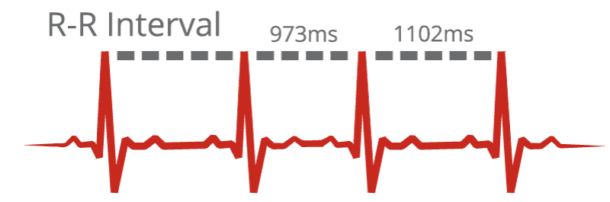
The image shows an electrocardiograph reading of heart rate. Each spike in the reading represents a heart beat. This shows a time difference in between each heart beat (973ms in one vs 1102ms in the next). Image from: https://elitehrv.com/what-is-heart-rate-variability
Heart Rate Variability and Health
Heart Rate Variability is easy to monitor and track over time. Many wellness and performance watches are now capable of measuring and tracking HRV. Heart Rate Variability is an indirect measure of systemic inflammation, with lower HRV scores suggesting greater SNS activation and inflammation. Sympathetic nervous system activation is beneficial and necessary in times of high energy demand. However, if the SNS is continually dominant at rest, it can lead to chronic inflammation. Chronic inflammation is linked to the development of many different diseases, including diabetes, cancer, autoimmune disease, and cardiovascular disease. Developing lifestyle practices to enhance PNS activation at rest can provide disease prevention and improve overall health and well-being. Aerobic exercise, sleep, diet, emotional/mental stress, environmental stress, and many other variables influence your HRV.
If you’d like to learn more about HRV and how to improve your score, I highly recommend this article and other resources from Elite HRV. I’ve benefited and learned from their courses and the information provided on their website. We are not associated with Elite HRV.
Craniosacral Therapy and Heart Rate Variability
Craniosacral Therapy (CST) can improve parasympathetic nervous system activation at rest. Many clients report feeling more calm and “present” after a session. Research has not identified how CST improves PNS activation. Among my personal theories is that CST techniques help alleviate physical tension and stress on the central nervous system structures around the brain and spinal cord. Cranial techniques address soft tissue restrictions that alter the normal movement pattern of the cranial bones. Along the spine, the craniosacral membrane (dural tube) has soft tissue connections to each vertebra. Decreased joint mobility or altered muscular movement patterns can also increase tension in the craniosacral system. CST can address these restrictions and improve the quality and balance of the craniosacral rhythm.
